
Did You Know Sitting at a Desk All Day Could Lead to Painful Conditions?
If your mother is constantly telling you to stand up straight, if you find yourself with shoulder pain after a long day at work, or if you notice you are developing a hunchback, chances are you have Upper Crossed Syndrome (UCS).
UCS is actually a muscle imbalance in the head and shoulders that is often found in people who work at a desk or sit with poor posture for the majority of the day.
As a result, a person has weak cervical flexors and lower trapezius muscles (which form a straight line when looking from the side) and tight upper trapezius and pectoral muscles (forming the cross when looking from the side).
This double-edged sword often results in a forward head posture, a hunched appearance, and shoulder pain.
What is upper-crossed syndrome and how can it be treated?
The treatment for UCS is to see a physical therapist. Not only can they eliminate underlying causes, they can also create a custom treatment plan to address your pain level as well as your symptoms.
Working with a PT, you will find your treatment divided into three parts – stretching the upper trapezius and pectoral muscles, strengthening the cervical flexors and lower trapezius muscles, and training you to make postural adjustments throughout the day to avoid future recurrence.
Postural Correction
All of the stretching and strengthening in the world will be for naught if you don’t address the problem that got you here in the first place – your posture.
Stand with your back and the back of your head against the wall, feet about six inches away from the wall. Your neck should be no more than two fingers-width from the wall. This simple trick is often enough to remind your body of what it feels like to have proper posture.
Consider raising your desk to allow for a more neutral seated position. Pay attention to your posture as you text, type on a computer, cook in the kitchen, or drive. Train your body to make appropriate adjustments in each of these positions in order to prevent UCS from recurring.
Ultimately, treating Upper Crossed Syndrome is an investment into your future health. Not only will you look better from a postural perspective, you will see bigger gains in your athletic performance. For more information about UCS or to find out more about stretching and strengthening exercises, contact your physical therapist today.
Strengthening
Strengthening exercises targeting the cervical flexors and lower trapezius muscles are easy to perform. The most basic of which is the chin tuck. First, lay on your back with your knees bent, without a pillow to support your head.
Next, keeping the back of your head on the floor and your mouth closed, bring your chin as close to your neck as possible. Keeping your head straight, hold this position for 10 seconds, 10 to 12 times.
Stretching
In every person who has UCS, the first item of business is to restore the shortened muscles. According to Sherrington’s Law of reciprocal inhibition, when one muscle is tightened or shortened the opposite muscle relaxes.
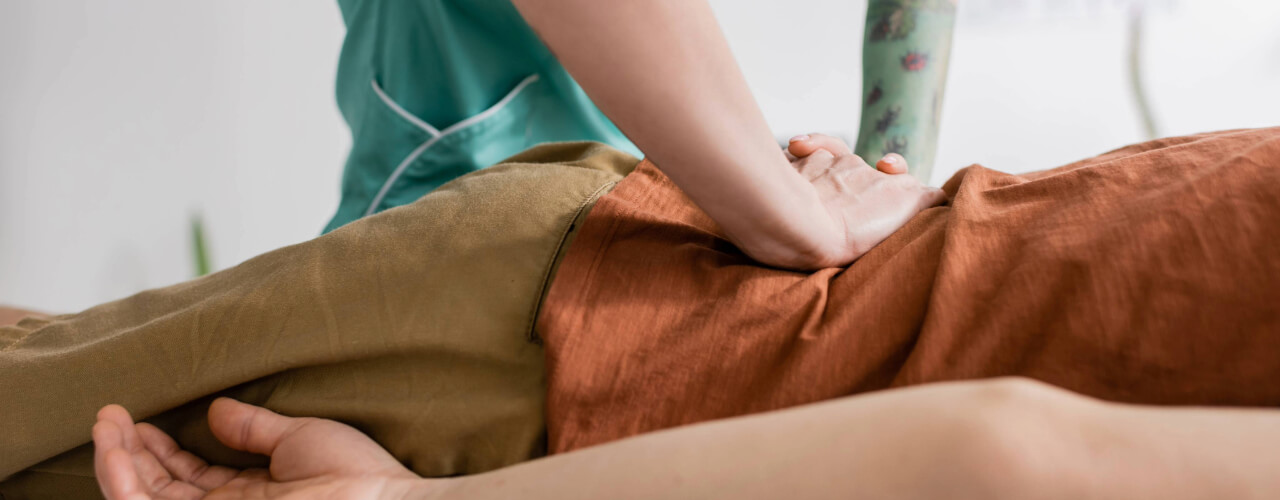
Likewise, strengthening the weak muscle is an exercise in futility of the tight muscle. Your physical therapist will recommend a series of stretches and other therapies, like myofascial release and massage, to lengthen the upper trapezius and pectoral muscles.
Find relief with physical therapy
If you’re noticing pain from hunching over your desk, physical therapy can help detect the root cause of the pain and provide a treatment plan that works best for you.
A physical therapist can test to see what the cause of your pain is and help improve your posture, therefore also relieving your pain.
As stated by the American Physical Therapy Association,
“The physical therapist uses tests and measures to assess an individual’s structural alignment. Optimal posture is a state of musculoskeletal balance and skeletal alignment that may protect the individual against injury or progressive deformity. Responses monitored at rest, during activity, and after activity may indicate the presence or severity of an impairment, activity limitation, or participation restriction.”
If your posture is causing you pain, we can help.
How can I get started?
Looking for more assistance in treating your desk-related aches and pains? We can help!
Contact our office today to schedule a consultation with one of our physical therapists and get started on the first steps toward relief. Live your life comfortably with physical therapy!